How to write about place is a question that cuts across the career of the South African Ivan Vladislavić. The questions of place and space are pressing ones in the context of South Africa, where the transition to democracy in 1994 included a redrawing of the national map, and the last three decades have seen the large-scale transformation of urban centers such as Johannesburg. What defines Johannesburg a literary city? asks the critic Jeanne-Marie Jackson. From this unfurls a series of reflections about the writer’s relationship to place and the various ways in which narrative form can be bent to capture the experience of place—and in particular the experience of a place as it changes across time. The resulting work may feel fragmentary, Ivan allows, but that is a function of the nature of place rather than an imposition on the part of the writer. Finally, the conversation turns toward Ivan’s choice to study Afrikaans literature in the 1970s. As a tradition often at odds with Afrikaner politics and urgently concerned with the world Ivan himself inhabited, reading the work of Afrikaans writers such as Ingrid Winterbach, Etienne Leroux, André Brink, and Breyten Breytenbach offered a vital counterpoint to Ivan’s training in the English canon. Ivan closes by fondly remembering the teacher who introduced him to the writer’s notebook, a habit that continues to be crucial to his practice today.
Mentioned in this episode:
The Folly
Double Negative
The Near North
Zoë Wicomb, You Can’t Get Lost in Cape Town
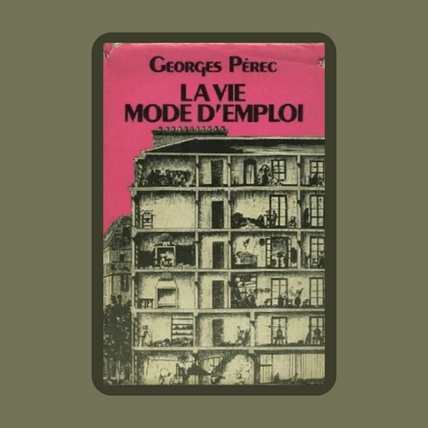
Georges Pérec
Gauteng
John Miles, Ampie Coetzee, Ernst Lindenberg, and Taurus Publishers
Marlene van Niekerk
Nadine Gordimer
The Goon Show
Listen and Read:
Audio: Place presents itself to you in fragments: Ivan Vladislavić and Jeanne-Marie Jackson (MAT)
11.1 Indie Presses and the Literary Ecosystem: Meg Reid and Will Evans – Novel Dialogue
- 11.1 Indie Presses and the Literary Ecosystem: Meg Reid and Will Evans
- 10.5 The Novel as Instrument: Sinan Antoon and Michael Allan (MAT)
- 10.4 Place Presents Itself To You in Fragments: Ivan Vladislavić and Jeanne-Marie Jackson (MAT)
- 10.3 Just Slightly Outside the Circle: Peter Orner and Sarah Wasserman (EH)
- 10.2 Beautiful Sentences Matter. Billy-Ray Belcourt and Matt Hooley (SW)
Cover design. La Vie Mode d’Emploi, Georges Perec, Hachette Littératures, 1979. Front cover.

