Can a novel with a singular voice also be a chorus? Can it reject the conventions of the novel and still be a novel? Poet, essayist, and novelist Billy-Ray Belcourt tells critic Matt Hooley how his desire to write a novel that “would sound like something else,” led him to produce A Minor Chorus, his experimental debut novel. Together they consider how Billy-Ray’s vulnerable, first-person narrator makes room for other voices, or more precisely, how it becomes “a voice that could focalize the desires of a community.” Billy-Ray discusses how his influences— queer theory, indigenous novelists, and contemporary autofiction—harmonize in his search for a new form. While author and critic trace the circuits of grief and melancholy that run from Barthes to Billy-Ray, their conversation is joyful, reminding listeners that romance and intimacy sustain us and that beautiful sentences matter. His answer to this season’s signature question attests to the way that even the classroom can be refashioned, like the novel, into a chorus.
Mentioned in this episode:
By Billy-Ray Belcourt:
A Minor Chorus
A History of My Brief Body
This Wound is a World
Also mentioned:
The Summer Day
“Arundhati Roy Sees Delhi as a Novel”
Rachel Cusk, The Shakespeare and Company Interview
“The State of the Political Novel: An Interview with Édouard Louis”
“100 Things About Writing a Novel”
Mourning Diary
Ann Cvetkovich
Joshua Whitehead
Mourning and Melancholia
Listen and Read:
Audio: Beautiful Sentences Matter: Billy-Ray Belcourt and Matt Hooley (SW)
Transcript: 10.2 Beautiful Sentences Matter: Billy-Ray Belcourt and Matt Hooley (SW)
11.1 Indie Presses and the Literary Ecosystem: Meg Reid and Will Evans – Novel Dialogue
- 11.1 Indie Presses and the Literary Ecosystem: Meg Reid and Will Evans
- 10.5 The Novel as Instrument: Sinan Antoon and Michael Allan (MAT)
- 10.4 Place Presents Itself To You in Fragments: Ivan Vladislavić and Jeanne-Marie Jackson (MAT)
- 10.3 Just Slightly Outside the Circle: Peter Orner and Sarah Wasserman (EH)
- 10.2 Beautiful Sentences Matter. Billy-Ray Belcourt and Matt Hooley (SW)
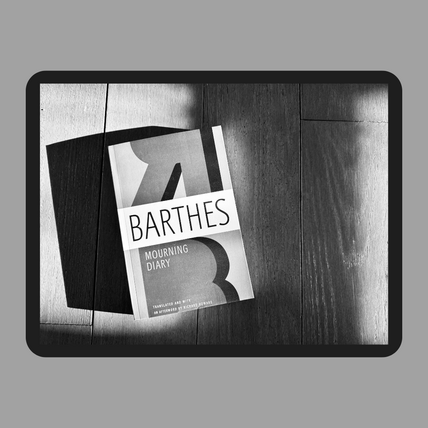
Cover design. Mourning Diary, Roland Barthes, Hill and Wang, 2012. Front cover.

