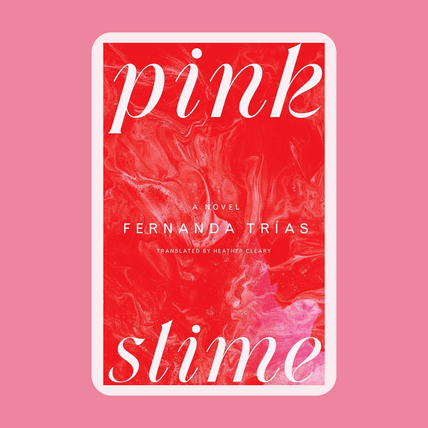
Fernanda Trías’s Pink Slime (Mugre rosa) was first published in Spanish in October 2020, several months into a global pandemic that had bent our world into something uncannily similar to the one imagined in the Uruguayan writer’s fourth novel. Here, an environmental disaster that begins as red algae bloom in the oceans has produced a toxic wind that kills most living creatures. As the plague spreads, the protagonist chooses to remain in her coastal city, caring for a boy with a rare genetic disorder. Published in an English translation by Heather Cleary as the pandemic waned, Pink Slime continues to push against the limits of genre categories, balancing on that delicate edge between science fiction and literary realism.
In dialogue with Cleary—a prolific translator of contemporary Latin American fiction who is also a critic and scholar of translation—Trías unfolds the many different ideas explored in Pink Slime, including the ethical complexities of writing about illness and disability, the difficult intimacies of mothers and daughters (and other potentially toxic relationships), how it is that we experience time and memory, and what it means to live with the looming threat of ecological collapse. Pink Slime, like Trías’s other novels, is also interested in the narrative potential of confined spaces, which constrain the movement of plot and allow for new possibilities in building characters’ psychological depth. The conversation also gets into the question of time and narrative tense when it comes to narrating the experience of disaster—a question that was crucial for the novelist as much as the translator. Together, Trías and Cleary also get into the intricacies of translation, including word choice, sound, rhythm, breath, and how to make jokes work across languages.
Mentioned in this episode:
The Translator’s Visibility: Scenes from Contemporary Latin American Fiction
Prader-Wilis syndrome
Vivian Gornick, Fierce Attachments: A Memoir
N. Pino Luna
The other pink slime
Trías, El monte de las furias
Plumsock Endowed Residency, Yaddo Artist’s Community (the residency that Trías briefly names toward the end of the conversation)
Listen and Read:
Audio: “That In Between Time:” Fernanda Trías and Heather Cleary (MAT)
Transcript: 9.4 “That In Between Time:” Fernanda Trías and Heather Cleary (MAT)
11.1 Indie Presses and the Literary Ecosystem: Meg Reid and Will Evans – Novel Dialogue
- 11.1 Indie Presses and the Literary Ecosystem: Meg Reid and Will Evans
- 10.5 The Novel as Instrument: Sinan Antoon and Michael Allan (MAT)
- 10.4 Place Presents Itself To You in Fragments: Ivan Vladislavić and Jeanne-Marie Jackson (MAT)
- 10.3 Just Slightly Outside the Circle: Peter Orner and Sarah Wasserman (EH)
- 10.2 Beautiful Sentences Matter. Billy-Ray Belcourt and Matt Hooley (SW)
Tatone, Alicia. Cover design. Pink Slime, Fernanda Trías, Scribner, 2024. Front cover.

