What work can genre do today? And can the genre system become more than a method of reductive containment and market segmentation—can it be a generative source of imaginative chaos? Few are as qualified to address these questions as Lauren Beukes, whose simultaneous embrace of genres from science fiction to crime to horror and refusal to abide within their borders—what she calls her “Big Fuck You Energy”—has rendered her, by her own account, “basically unshelvable.” Beukes is joined by crime fiction scholar (and novelist) Andrew Pepper of Queen’s University Belfast for a conversation that dances across her oeuvre’s many genres. They delve into how Beukes first encountered genre through the allegories that writers used to navigate the apartheid state of South Africa; how Beukes’ experiences of femicidal violence and police apathy inspired her work in genre-bent crime (“At least in novels I get to have justice,” she tells us); the inflection of dystopia from different global perspectives; and the role of speculative fiction in helping clarify political enemies in an age of obfuscation. Pepper and Beukes also think about genre in more practical terms, from the logistics of keeping track of plotlines when crafting time travel or multiverse novels to what it means to be a “high concept” author in a market designed for distracted audiences.
Mentioned in this episode:
Lauren Beukes, Moxyland, Zoo City, The Shining Girls (and AppleTV adaptation), Broken Monsters, Bridge, Afterland
Margaret Atwood and speculative fiction
China Miéville and the New Weird
Kazuo Ishiguro
Andrew Bucklan, The Ugly Noo Noo
Lauren Berlant
Ivy Pochoda, These Women
Danya Kukafka, Notes on an Execution
Hannibal Lecter
Crooked and Obscene
Bret Easton Ellis, American Psycho
Charles Dickens, Great Expectations
Rick and Morty
Spider-Man: Into the Spider-Verse
Everything Everywhere All At Once
Doctor Who
E.L. Doctorow
Plotters vs. Pantsers
Severance
Nnedi Okorafor
Rebecca Solnit, Hope in the Dark
A.K. Blakemore, The Glutton
Listen and Read:
Audio: Monstrous Dreaming: Lauren Beukes and Andrew Pepper (RB)
Transcript: 9.2 Monstrous Dreaming: Lauren Beukes and Andrew Pepper (RB)
11.1 Indie Presses and the Literary Ecosystem: Meg Reid and Will Evans – Novel Dialogue
- 11.1 Indie Presses and the Literary Ecosystem: Meg Reid and Will Evans
- 10.5 The Novel as Instrument: Sinan Antoon and Michael Allan (MAT)
- 10.4 Place Presents Itself To You in Fragments: Ivan Vladislavić and Jeanne-Marie Jackson (MAT)
- 10.3 Just Slightly Outside the Circle: Peter Orner and Sarah Wasserman (EH)
- 10.2 Beautiful Sentences Matter. Billy-Ray Belcourt and Matt Hooley (SW)
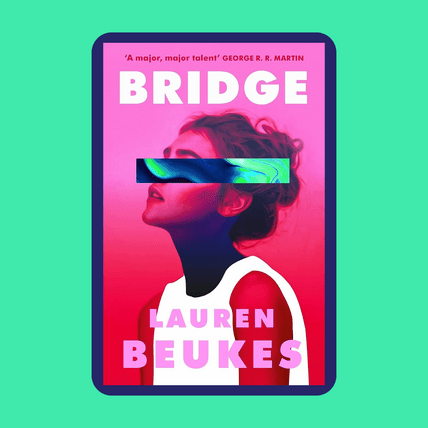
Cover design. Bridge, Lauren Beukes, Penguin Books Ltd, 2024. Front cover.


One thought on “9.2 Monstrous Dreaming: Lauren Beukes and Andrew Pepper (RB)”
Comments are closed.