It’s a bit surprising to hear a writer known for building worlds that incorporate deep historical research and elaborate technological details extol the virtues of play, but Ken Liu tells critic Rose Casey and host Sarah Wasserman that if “your idea of heaven doesn’t include play, then I’m not sure it’s a heaven people want to go to.” It turns out that Ken—acclaimed translator and author of the “silkpunk” epic fantasy series Dandelion Dynasty and the award-winning short story collection The Paper Menagerie—is deeply serious about play. Speaking about play as the key to technological progress, Ken and Rose discuss the importance of whimsy and the inextricable relationship between imagination and usefulness. For Ken, whose Dandelion Dynasty makes heroes of engineers instead of wizards or knights, precise machinery and innovative gadgets are born, like novels, of imagination. Ken himself might be best described as a meticulous, dedicated tinkerer—a writer playing with the materials and stories of the past to help us encounter new worlds in the present. So even if trying to explain his craft is “like asking fish how they swim,” Ken jumps in and discusses how he writes at such different lengths (hint: the longer the book, the more elephantine) and what he makes of different genre labels, from fantasy to historical fiction. We also learn why Ken is a fan of Brat Summer and still thinking about the Roman Empire.
Mentioned in this episode:
Ken Liu, Speaking Bones (2022), The Veiled Throne (2021), The Wall of Storms (2017), The Grace of Kings (2016), The Paper Menagerie and Other Stories (2016)
Cixin Liu, The Three-Body Problem (2014)
Rose Casey, Jessica Wilkerson, Johanna Winant, “An Open Letter from Faculty at West Virginia University” (2023)
Rose Casey, “In Defense of Higher Education” (2024)
Ursula K. LeGuin, “The Ones Who Walk Away from Omelas” (1973)
Homer, The Odyssey
Virgil, The Aeneid
John Milton, Paradise Lost
A.M. Turing, “Computing Machinery and Intelligence” (1950)
Brat Summer
Listen and Read:
Audio: Novels are Like Elephants: Ken Liu and Rose Casey (SW)
Transcript: 9.1 Novels are Like Elephants: Ken Liu and Rose Casey (SW)
11.2 Taking Apart a Metaphor: Dan Sinykin and Sarah Brouillette on the Literary Ecosystem – Novel Dialogue
- 11.2 Taking Apart a Metaphor: Dan Sinykin and Sarah Brouillette on the Literary Ecosystem
- 11.1 Indie Presses and the Literary Ecosystem: Meg Reid and Will Evans
- 10.5 The Novel as Instrument: Sinan Antoon and Michael Allan (MAT)
- 10.4 Place Presents Itself To You in Fragments: Ivan Vladislavić and Jeanne-Marie Jackson (MAT)
- 10.3 Just Slightly Outside the Circle: Peter Orner and Sarah Wasserman (EH)
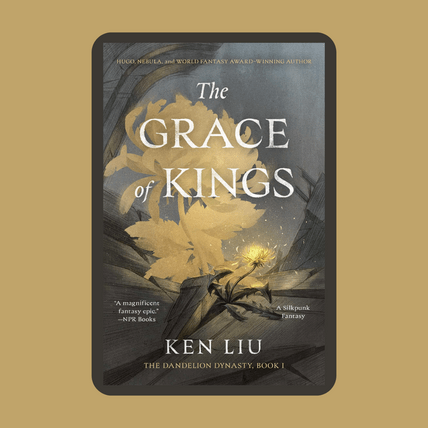
Cai, Rovina. Cover design. The Grace of Kings, Ken Liu, Saga Press, 2016. Front cover.

