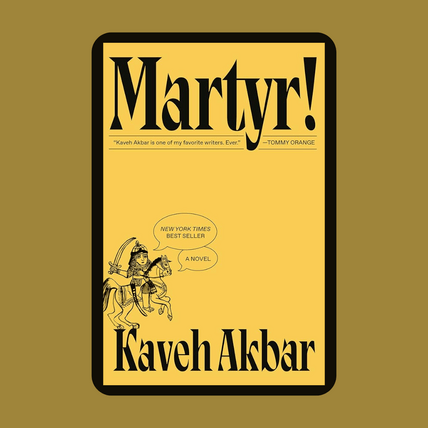
An unforgettable horse gallops through the pages of Kaveh Akbar’s best-selling novel Martyr! (2024), but it is a figurative hastening toward failure and the limitations of language that Akbar discusses with critic Pardis Dabashi. In their conversation, Kaveh considers writing both as an escape from the confines of the self and as a vehicle for expressing its contradictions. Together they explore which forms might best capture the ambivalence and polyphony of the human mind, the contours of Iranian American identity, and the spiritual beauty of everyday existence. Whether discussing neurolinguistics or the affordances of poetry, Kaveh contemplates the limits of language: how can we write what we think, when we struggle to know what—or how—we think? This conversation goes deep into the psyche in order to reach far beyond it. Even Kaveh’s deeply personal response to the signature question demonstrates that the places farthest away from us may also be found within.
Mentioned in this episode:
By Kaveh Akbar:
Martyr!
The Penguin Book of Spiritual Verse (editor)
Calling a Wolf a Wolf
Also mentioned:
My Uncle Napoleon
To the Lighthouse
Ars Poetica
Ferdowsi
The Palm-Wine Drinkard and My Life in the Bush of Ghosts
The Tempest
Listen and Read:
Audio: To gallop again and again into failure: Kaveh Akbar and Pardis Dabashi (SW)
Transcript: 8.2 To gallop again and again into failure: Kaveh Akbar and Pardis Dabashi (SW)
10.2 Beautiful Sentences Matter. Billy-Ray Belcourt and Matt Hooley (SW) – Novel Dialogue
- 10.2 Beautiful Sentences Matter. Billy-Ray Belcourt and Matt Hooley (SW)
- 10.1 "Extreme Circumstances, Extreme Reactions:” Aaron Gwyn and Sean McCann (JP)
- We Better Laugh About It: A Discussion with Álvaro Enrigue and Maia Gil’Adí
- 9.5 Who Owns These Tools? Vauhini Vara and Aarthi Vadde (SW)
- 9.4 “That In Between Time,” Fernanda Trías and Heather Cleary (MAT)
Huang, Linda. Cover design. Martyr!, Kaveh Akbar, Alfred A. Knopf, 2024. Front cover.
 Novel Dialogue