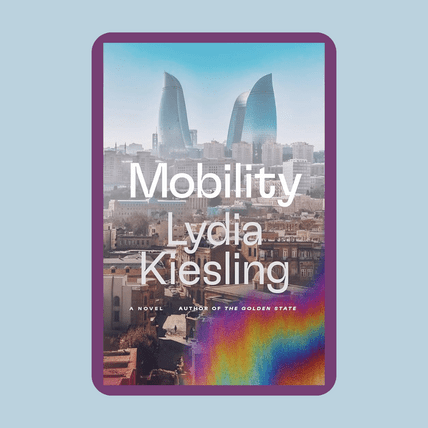
What does it mean for a novel to think globally? And can a global novel concerned with the macro movements of capital and labor still exist in the form of a bildungsroman? This conversation between Lydia Kiesling and Megan Ward takes up questions of form and political consciousness in the novel, globality and rootedness, capitalism and the yearning for things, optimization and wellness culture, and so much more. Lydia Kiesling’s first novel, The Golden State, was a 2018 National Book Foundation “5 under 35” honoree. Her second novel, Mobility, is the first book in a new imprint with Crooked Media. Lydia and Megan discuss seeing the world from a foreign service perspective, the damage wrought by cultures of individuality, and why more novels aren’t set in Azerbaijan. Lydia talks about how the close reading skills that she gained from an English major provide a way of reading the world that is underappreciated by our contemporary culture of utilitarianism. From wet bun hair styles to how we want novels to speak about progressive politics, this wide-ranging conversation wraps up with Lydia’s excellent answer to Season 8’s signature question.
Mentioned in this episode:
Of Human Bondage, Somerset Maugham
Oil!, Upton Sinclair
Namwali Serpell
Timothy Morton
How to Blow Up a Pipeline, Andreas Malm
Mineral Rites, Bob Johnson
Listen and Read:
Audio: Dirt Bag Novels: Lydia Kiesling in Conversation with Megan Ward (CH)
Transcript: 8.1 Dirt Bag Novels: Lydia Kiesling in Conversation with Megan Ward (CH)
11.1 Indie Presses and the Literary Ecosystem: Meg Reid and Will Evans – Novel Dialogue
- 11.1 Indie Presses and the Literary Ecosystem: Meg Reid and Will Evans
- 10.5 The Novel as Instrument: Sinan Antoon and Michael Allan (MAT)
- 10.4 Place Presents Itself To You in Fragments: Ivan Vladislavić and Jeanne-Marie Jackson (MAT)
- 10.3 Just Slightly Outside the Circle: Peter Orner and Sarah Wasserman (EH)
- 10.2 Beautiful Sentences Matter. Billy-Ray Belcourt and Matt Hooley (SW)
Gaffney, Evan. Cover design. Mobility, Lydia Kiesling, Crooked Media Reads, 2023. Front cover.

