Building parallels between technology and the human imagination, Masande Ntshanga’s conversation with Magalí Armillas-Tiseyra explains how cities are like machines and how South African history resembles some of the most sinister versions of techno-futurism. Masande is the author of two novels: The Reactive, winner of a Betty Trask Award in 2018, and Triangulum, nominated for the 2020 Nommo Awards for Best Novel in 2020 by the African Speculative Fiction Society. His responses to Magalí’s questions interweave autobiography and history, showing how when you venture into “underwritten spaces” in South Africa, realism starts to seem like speculation. Masande moves from playing bootleg Nintendo and hacking Lego sets in Ciskei, a “homeland” under the apartheid government’s Bantustan system, to data mining and novel writing in the global cities of Cape Town and Johannesburg. All the while, technology is never something “we’re resigned to experiencing” and “endorsing” in fiction—it can be a medium of contemplation as well as conquest. Masande and Magalí are also interested in the queer intimacies of young people busy forming their own “micro-tribes.” Especially young people who are reading the global phenomenon that is Stephen King by moonlight, when they might be just a little too young for it.
Mentioned in this episode:
Masande Ntshanga, The Reactive, Triangulum, and the short story “Space”
Samuel R. Delany, Equinox
“Hauntology,” from Jacques Derrida in Spectres of Marx
Ciskei
Masande Ntshanga’s essay “Technologies of Conquest” in The Creative Arts: On Practice, Making, and Meaning (Dryad Press, 2024)
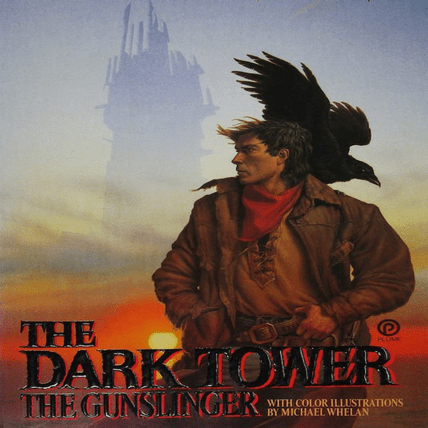
Stephen King, The Dark Tower I: The Gunslinger
Bonus mention: Lost Libraries, Burnt Archives, an edited volume of short stories, artworks, poems and essays that engage with the tragic destruction of the African Studies Library at the University of Cape Town in April 2021.
Listen and Read:
Audio: Machine, System, Code: Masande Ntshanga and Magalí Armillas-Tiseyra (EH)
Transcript: 7.5 Machine, System, Code: Masande Ntshanga and Magalí Armillas-Tiseyra (EH)
10.5 The Novel as Instrument: Sinan Antoon and Michael Allan (MAT) – Novel Dialogue
- 10.5 The Novel as Instrument: Sinan Antoon and Michael Allan (MAT)
- 10.4 Place Presents Itself To You in Fragments: Ivan Vladislavić and Jeanne-Marie Jackson (MAT)
- 10.3 Just Slightly Outside the Circle: Peter Orner and Sarah Wasserman (EH)
- 10.2 Beautiful Sentences Matter. Billy-Ray Belcourt and Matt Hooley (SW)
- 10.1 "Extreme Circumstances, Extreme Reactions:” Aaron Gwyn and Sean McCann (JP)
Image credit: GUNSLINGER ’88 ROLAND by Michael Whelan


One thought on “7.5 Machine, System, Code: Masande Ntshanga and Magalí Armillas-Tiseyra (EH)”
Comments are closed.