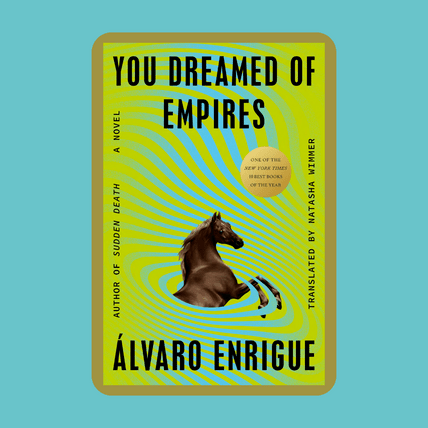
Álvaro Enrigue and critic Maia Gil’Adí begin their conversation considering translation as a living process, one that is internal to the novel form. Álvaro, author of the trippy You Dreamed of Empires, explains how the opening letter to his translator Natasha mirrors the letter to his editor, Teresa, in Spanish, and how both letters become part of the fiction. Fitting for a novel that crosses Nahua and Mayan, Moctezuma and Cortés, Mexican history and the glam rock band T. Rex. The English translation—which Álvaro calls the book of Natasha—is longer, filled with changes and additions and revisions, and so translation becomes “another life for the book.” From the living book to its contents, Maia asks how You Dreamed of Empires blends the gorgeous and the grotesque, slapstick humor and extreme violence, historical detail and mischievous metafictional departures. Álvaro links his work to Season 9’s theme of TECH by pointing out the novel’s longstanding use as a tool to laugh about the powerful, to tell them that what they’re saying is not true, and to articulate politics through contradiction and humor. After discussing the encounter of Moctezuma and Cortés (or really, of their translators, including a very magical bite of cactus) as the moment that changes everything in history, Álvaro makes a surprising historical swerve in his answer to this season’s signature question.
Mentioned in this episode:
Álvaro Enrigue, Sudden Death, You Dreamed of Empires, Now I Surrender
Nahua
Natasha Wimmer
Teresa Ariño, Anagrama
Sergio Pitol, Enrique Vila-Matas, Javier Marías, Roberto Bolaño
Miguel de Cervantes, Don Quixote; Laurence Sterne; Jonathan Swift, Gulliver’s Travels
Octavio Paz saying New Spain was a kingdom in One Earth, Four or Five Worlds: Reflections on Contemporary History, translated by Helen R. Lane.
Edward Said
Lèse-majesté
T. Rex, “Monolith”
Gonzalo Guerrero
The Colegio de Santa Cruz de Tlatelolco
José Emilio Pacheco
Michel Foucault
Michelangelo
Saint Paul, Epistle to the Romans
Noam Chomsky
Tlaxcalas
Listen and Read:
Audio: We Better Laugh About It: Álvaro Enrigue and Maia Gil’Adí
Transcript: 9.6 We Better Laugh About It: Álvaro Enrigue and Maia Gil’Adí
10.3 Just Slightly Outside the Circle: Peter Orner and Sarah Wasserman (EH) – Novel Dialogue
- 10.3 Just Slightly Outside the Circle: Peter Orner and Sarah Wasserman (EH)
- 10.2 Beautiful Sentences Matter. Billy-Ray Belcourt and Matt Hooley (SW)
- 10.1 "Extreme Circumstances, Extreme Reactions:” Aaron Gwyn and Sean McCann (JP)
- We Better Laugh About It: A Discussion with Álvaro Enrigue and Maia Gil’Adí
- 9.5 Who Owns These Tools? Vauhini Vara and Aarthi Vadde (SW)
Dewey, Amanda. Cover design. You Dreamed of Empires, Álvaro Enrigue, Riverhead Books, 2024. Front cover.
 Novel Dialogue
One thought on “9.6 We Better Laugh About It: Álvaro Enrigue and Maia Gil’Adí”
Comments are closed.