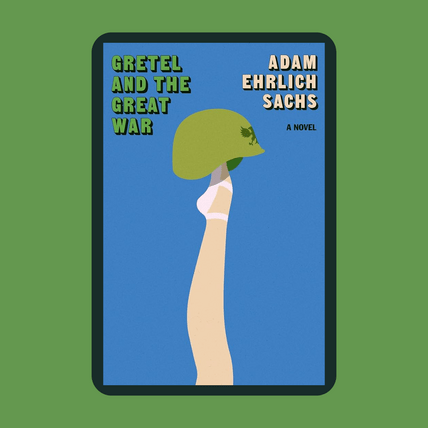
What happens when a novelist wants “nonsense and joy” but his characters are destined for a Central European sanatorium? How does the abecedarian form (i.e. organized not chronologically or sequentially but alphabetically) insist on order, yet also embrace absurdity? Here to ponder such questions with host John Plotz are University of Wisconsin–Madison’s Sunny Yudkoff (last heard on ND speaking with Sheila Heti) and Adam Ehrlich Sachs, author of Inherited Disorders, The Organs of Sense, and the recently published Gretel and the Great War. Sachs has fallen under the spell of late Habsburg Vienna, where the polymath Ludwig Wittgenstein struggled to make sense of Boltzmann’s physics, Arnold Schoenberg read the acerbic journalist Karl Kraus, and everyone, Sachs suspects, was reading Grimms’ Fairy Tales, searching for the feeling of inevitability only narrative closure can provide. Beneath his OULIPO-like attachment to arbitrary orders and word-games, though, Sachs admits to a desire for chaos.
Mentioned in this episode:
Thomas Bernhard, later 20th century Austrian experimental novelist
Heinrich von Kleist, “Michael Kohlhass” Romantic-era German writer
Italo Calvino, If on a Winter’s Night a Traveler
OULIPO, home of French literary experimentalists like Perec and Raymond Queneau
Georges Perec’s most famous experiment is Life: A User’s Manual (although John is devoted to “W: or the Memory of Childhood”)
Dr. Seuss, On Beyond Zebra! (ignore John calling the author Dr Scary, which was a scary mistake…)
Marcel Proust: was he a worldbuilder and fantasist, as Nabokov says or, as Doris Lessing claims, principally an anatomist of French social structures, a second Zola?
Franz Kafka is unafraid of turning his character into a bug in a story’s first sentence.
Virginia Woolf in Mrs. Dalloway offers the reader a mad (Septimus) and a sane (Mrs. Dalloway herself) version of stream of consciousness: how different are they?
Cézanne, for example The Fisherman (Fantastic Scene)
The Pointillism of painters like Georges Seurat
Listen and Read:
Audio: Aspire to Magic but End Up With Madness: Adam Ehrlich Sachs speaks with Sunny Yudkoff (JP)
10.2 Beautiful Sentences Matter. Billy-Ray Belcourt and Matt Hooley (SW) – Novel Dialogue
- 10.2 Beautiful Sentences Matter. Billy-Ray Belcourt and Matt Hooley (SW)
- 10.1 "Extreme Circumstances, Extreme Reactions:” Aaron Gwyn and Sean McCann (JP)
- We Better Laugh About It: A Discussion with Álvaro Enrigue and Maia Gil’Adí
- 9.5 Who Owns These Tools? Vauhini Vara and Aarthi Vadde (SW)
- 9.4 “That In Between Time,” Fernanda Trías and Heather Cleary (MAT)
Merto, Alex. Cover design. Gretel and the Great War, Adam Ehrlich Sachs, Farrar, Straus and Giroux, 2024. Front cover.
 Novel Dialogue