.
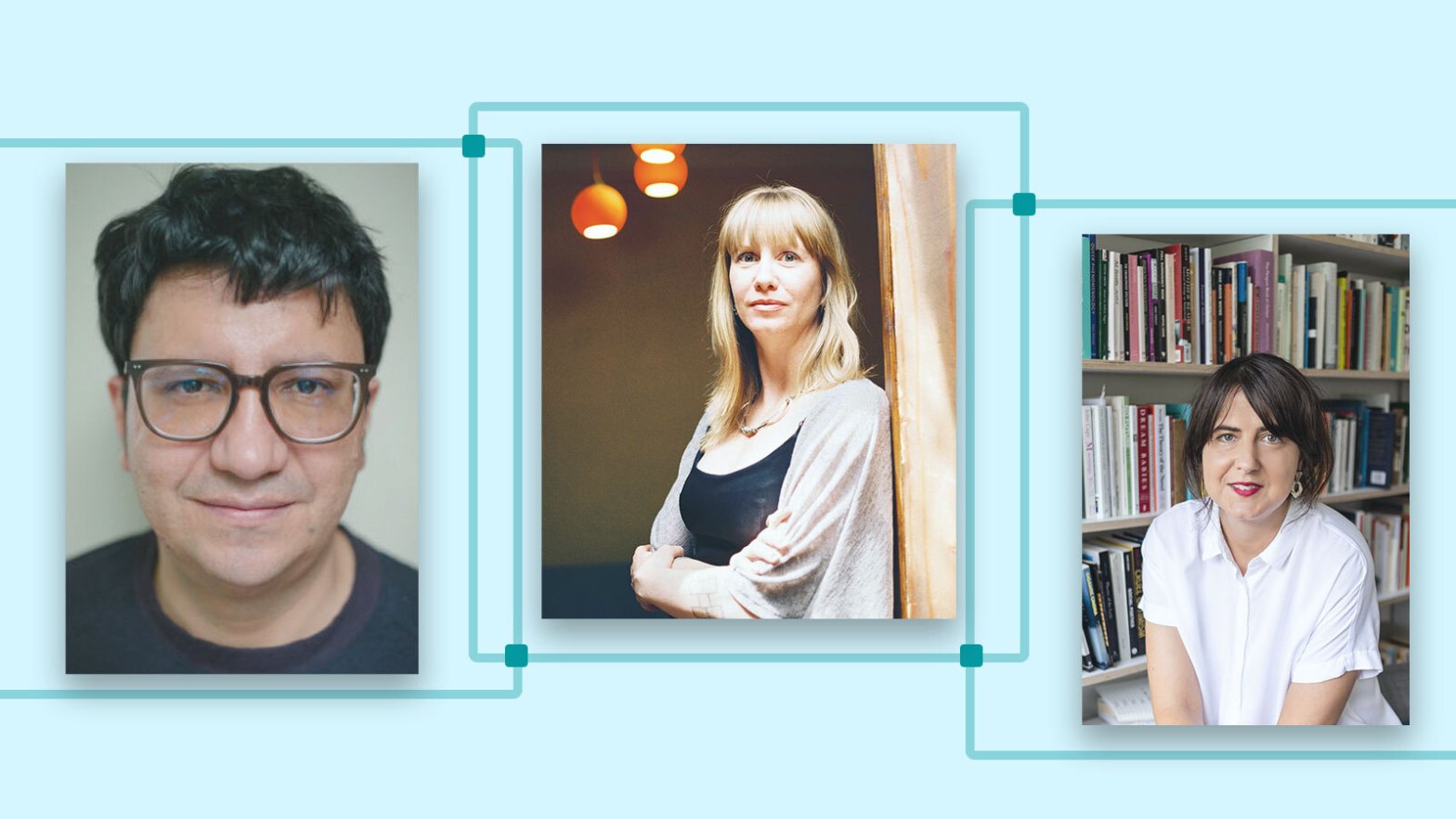
A novelist, a translator and a theorist of translation walk into a Zoom Room……Alejandro Zambra, Megan McDowell, and Kate Briggs provide the perfect start to Season 4 of Novel Dialogue. Our first themed season is devoted to translation in all its forms: into and out of English and also in, around, and over the borders between criticism and fiction. We talk to working translators, novelists who write in multiple languages, and we even time travel to discover older novels made new again in translation. How perfect then to begin with Kate, whose 2017 This Little Art is filled with translational brain-teasers: how do I translate characters speaking French in a german novel? what does it mean that “A translation becomes a translation only when somebody declares it to be one”?
In this episode, Alejandro and Megan discuss their working relationship and share both Spanish and English passages from Alejandro’s most recent novel, Chilean Poet. There follows a dazzling discussion of poetry within novels, of struggling to be “reborn” as you learn a second language “as something that no longer goes without saying..” Alejandro proposes that to speak Spanish itself, (except “bestseller Spanish”) is already to pivot between the language as it’s spoken differently in different countries.. Finally, the new ND “signature question” engenders a cheerful tirade from Megan that brings the conversation to a delightfully feisty conclusion.
Mentioned in this episode:
Roland Barthes, The Preparation of the Novel; How to Live Together
Samanta Schweblin
Mariana Enriquez
Lina Meruane
Joseph Conrad
Vladimir Nabakov
Oulipo writers who chose rules to organize their writing: e.g.. Georges Perec wrote a novel without the letter e.
Wordsworth, “Nuns Fret Not at Their Convent’s Narrow Room”
Robert Browning as practitioner of “dramatic monologue” (or “double poem“)
Alfred, Lord Tennyson
Elizabeth Barrett Browning
Emily Brontë
Charlotte Brontë
Emily Dickinson
T. S. Eliot, “The Waste Land”
I. A. Richards
Randall Jarrell (“Gertrude spoke French so badly anyone could understand it…..”)
Listen and Read:
Audio: “Sometimes I’m just a little disappointed in English”
Transcript: 4.1 “Sometimes I’m just a little disappointed in English”
10.2 Beautiful Sentences Matter. Billy-Ray Belcourt and Matt Hooley (SW) – Novel Dialogue
- 10.2 Beautiful Sentences Matter. Billy-Ray Belcourt and Matt Hooley (SW)
- 10.1 "Extreme Circumstances, Extreme Reactions:” Aaron Gwyn and Sean McCann (JP)
- We Better Laugh About It: A Discussion with Álvaro Enrigue and Maia Gil’Adí
- 9.5 Who Owns These Tools? Vauhini Vara and Aarthi Vadde (SW)
- 9.4 “That In Between Time,” Fernanda Trías and Heather Cleary (MAT)
 Novel Dialogue