Our second episode on “The Literary Ecosystem” features scholars of contemporary literary culture Dan Sinykin and Sarah Brouillette in conversation with host Aarthi Vadde. Like the good close readers we all are, we begin by thinking about how the metaphor of the “literary ecosystem” works. Sarah values the way it brings relationships between cultural institutions to the foreground but prefers the base-superstructure model of Marxian critique. Dan, too, moves away from “naturalizing” metaphors, although he sees the ecosystem’s potential for pithily naming the interplay of literary production, circulation, and reception.
From here the conversation ranges widely as we consider the economic and social forces shaping contemporary literature – be they the conglomeration of publishing houses (see Dan’s Big Fiction) or the impact of platform capitalism upon authorial labor (see Sarah’s Content Machines and Aarthi’s We the Platform). We acknowledge the hollowing out of institutions meant to cultivate appreciation for literature and ponder the viability of platforms like Substack for reconstituting a literary sphere. Finally, what would a discussion of the literary ecosystem be without addressing the elephant in the room: AI. We bracket the author scandals to address the supporting players under threat: the translators, the audiobook narrators, the humans who bring books to readers across languages and formats. Come for the literary sociology; stay for the inside scoop on “prompting” a dark romance novel.
Mentioned in this episode:
Marx – base-superstructure model
Bruno Latour – actor-network theory
Sophie Bishop – Influencer Creep
Andrew deWaard – Derivative Media
Pierre Bourdieu – The Rules of Art (edited)
Listen and Read:
11.3 “Thank god for editors”: Imbolo Mbue and Sarah Dimick (RB) – Novel Dialogue
- 11.3 “Thank god for editors”: Imbolo Mbue and Sarah Dimick (RB)
- 11.2 Taking Apart a Metaphor: Dan Sinykin and Sarah Brouillette on the Literary Ecosystem
- 11.1 Indie Presses and the Literary Ecosystem: Meg Reid and Will Evans
- 10.5 The Novel as Instrument: Sinan Antoon and Michael Allan (MAT)
- 10.4 Place Presents Itself To You in Fragments: Ivan Vladislavić and Jeanne-Marie Jackson (MAT)
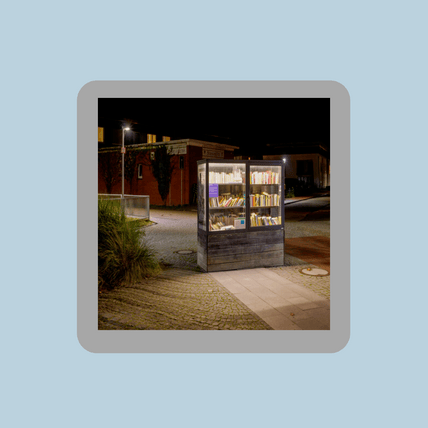
Image: Dietmar Rabich/ Wikimedia Commons/ “Norderney, Bücherschrank am Onnen-Visser-Platz — 2016 — 5436-42”/ CCBY-SA4.0

